State commission assessing impact of wild animals on farming and migration
Uttarakhand panel studying wildlife damage to crops, report due by March end
The Uttarakhand Rural Development and Migration Prevention Commission is conducting a detailed study to understand how wild animals are damaging agricultural fields across the state. The commission plans to submit its final report to the state government by the end of March. Officials say the study will help authorities understand the extent of the problem and find solutions to protect farmers and reduce migration from rural areas.
According to members of the commission, crop damage caused by wild animals has become a serious issue in many villages of Uttarakhand. Farmers in several districts regularly complain that animals enter their fields and destroy crops, which affects their income and livelihood.
The commission believes that this problem may also be contributing to migration from villages to towns and cities. Many families leave their homes in search of better opportunities when farming becomes difficult or unprofitable.
Sharad Singh Negi, the vice chairman of the commission, said that the study is currently in the data analysis stage. The team has collected information from nearly 7,000 gram panchayats across the state.
He explained that the study aims to measure how serious the damage is, which animals are responsible for it, and which crops are most affected. The commission is also trying to identify the regions where the problem is the most severe.
ALSO READ: Jaishankar speaks with Iran and Oman as India pushes for diplomacy in Middle East crisis
ALSO READ: Iran warns US after warship Iris Dena sunk in Indian Ocean, 87 killed
Study across thousands of villages
The large-scale study covers thousands of villages in different districts of Uttarakhand. Officials gathered data from local panchayats to understand the ground reality faced by farmers.
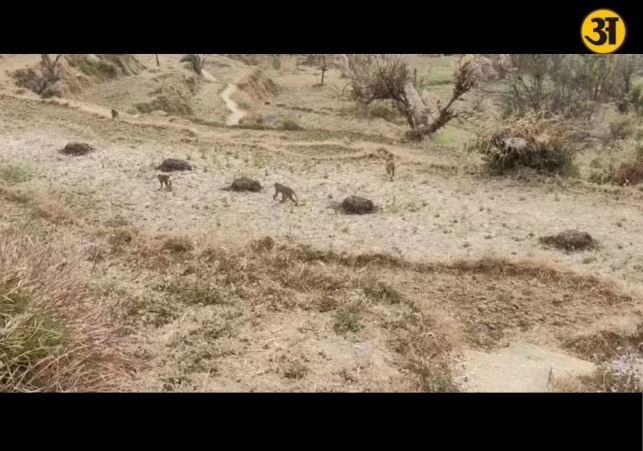
Negi said the nature of wildlife damage varies depending on the region. In some areas, monkeys are the main problem and frequently destroy crops and vegetables. In other regions, wild boars are responsible for major damage to fields.
Apart from these animals, nilgai, elephants and porcupines are also known to destroy crops. These animals often enter farms at night or early morning and eat or trample crops before farmers can stop them.
Because agriculture is the main source of livelihood in many villages, such damage directly affects farmers’ income. Even a single incident can wipe out months of hard work and investment.
According to Negi, earlier reports prepared by the commission have already suggested that wildlife damage is one of the factors that push people to migrate from rural areas. Although it is not the main reason, it still contributes to around 7 to 8 percent of migration cases.
The current study aims to examine this issue in greater detail and provide practical recommendations to the state government.
The commission is also looking at how farmers try to protect their crops using local solutions. Some villagers install simple fences, while others use lights, loud sounds or other methods to keep animals away from their fields.
By documenting these local methods, the commission hopes to identify effective strategies that can be used in other areas facing similar problems.
Government steps and migration concerns
The Uttarakhand government has already taken some steps to address the growing human–wildlife conflict. In December last year, Chief Minister Pushkar Singh Dhami announced plans to install solar fencing and sensor-based alert systems in different parts of the state.
Solar fencing can help keep animals away from fields by creating a protective boundary around farms. Sensor-based alert systems can detect animal movement and send warnings to farmers so that they can respond quickly.
These technologies are expected to reduce crop damage and help farmers feel more secure about their fields.
In addition, the Uttarakhand forest department last year granted conditional permission to hunt certain animals like wild boars and nilgai that frequently damage crops. This step was taken after repeated complaints from farmers who said these animals were causing heavy losses.
However, wildlife management remains a complex issue because authorities must balance conservation goals with the needs of local communities.
Another important focus of the commission’s study is the compensation system for farmers whose crops are destroyed by wild animals.
Negi said that although the government has provisions to compensate farmers for such losses, the process is often complicated and slow. Many farmers do not file compensation claims because they find the procedure difficult or time-consuming.
As a result, several affected families never receive financial support even after suffering losses.
The commission plans to examine these issues carefully and recommend ways to improve the compensation system so that farmers can receive assistance more easily.
The commission itself was established in August 2017 with the aim of studying migration patterns in Uttarakhand and suggesting ways to strengthen rural development.
Since its creation, the commission has produced several reports on migration trends. Its first statewide report, released in 2018, showed that more than 3,83,726 people temporarily migrated from villages between 2011 and 2018. During the same period, around 1,18,981 people permanently left their villages.
Another report published in March 2023 revealed that between 2018 and 2022, about 3,07,310 people migrated temporarily while 28,531 people moved away permanently.
These reports also highlighted the problem of abandoned villages. Between 2011 and 2018, as many as 734 villages were left deserted. Another 24 villages became empty between 2018 and 2022.
During the COVID-19 pandemic, many people returned to their villages when jobs in cities were affected. Around 3.5 lakh people came back to their villages or nearby areas during the first wave in 2020. Another 1.15 lakh people returned during the second wave in 2021.
However, according to the commission, most of these people eventually went back to cities once the situation improved.
The new report on wildlife damage is expected to provide important insights into how agriculture, wildlife conflict and migration are connected. The state government hopes that the findings will help create policies that protect farmers, strengthen rural livelihoods and reduce the need for people to leave their villages.
Related News